
Klara Krause · 22 September 2026
Navigating Compliance Requirements for Cloud-Based Note Platforms in Regulated Industries
Cloud-based note platforms have become essential tools across sectors where data handling faces strict oversight, and organizations in healthcare, finance, and legal fields must address multiple layers of regulatory demands when adopting these systems. These platforms allow teams to capture, share, and store information in real time, yet the same features that drive efficiency also create potential exposure points for sensitive records. Researchers have documented how failures in access controls or encryption can lead to violations that carry financial penalties and operational restrictions, which explains why compliance planning starts at the selection stage rather than after deployment.
Core Regulatory Frameworks Shaping Platform Selection
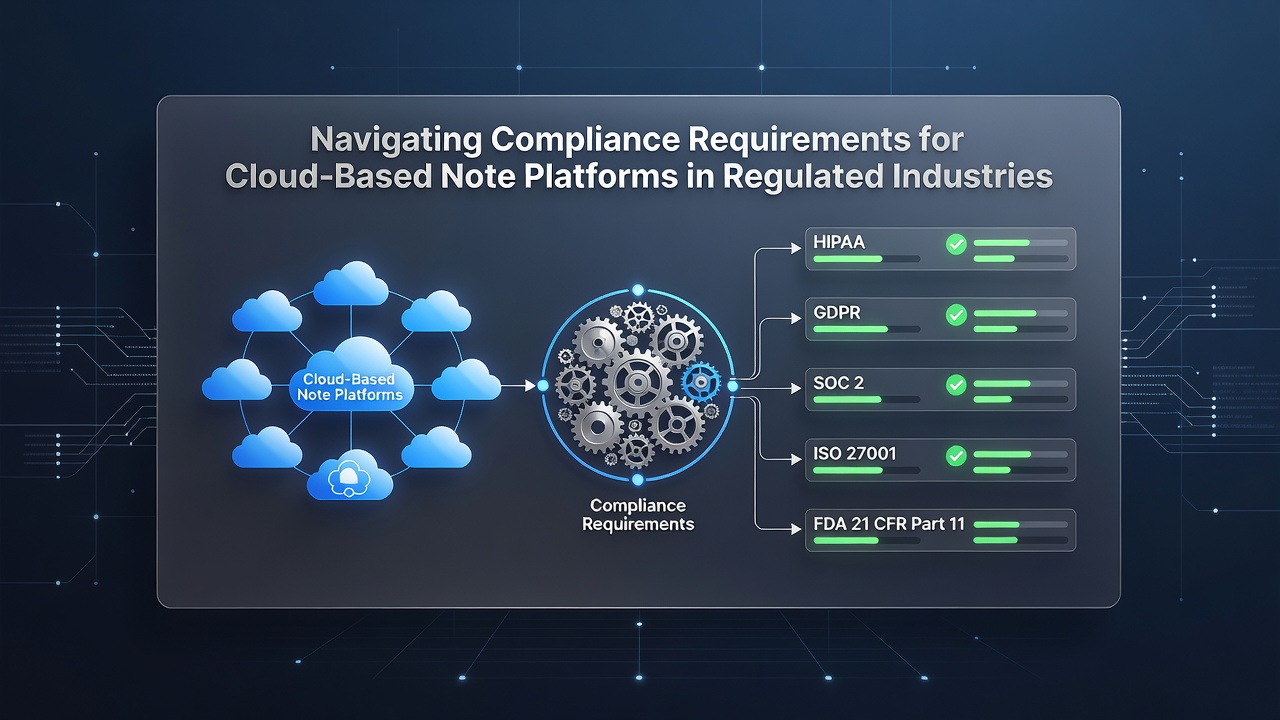
Organizations operating under the Health Insurance Portability and Accountability Act must ensure that note platforms meet standards for protected health information, including audit trails and encryption both at rest and in transit. Data from the U.S. Department of Health and Human Services shows that enforcement actions often cite inadequate vendor agreements as a primary factor in breaches. In parallel, entities handling European personal data follow the General Data Protection Regulation, which requires explicit consent mechanisms and the ability to export or delete records on demand. Observers note that companies frequently discover gaps only after mapping their note-taking workflows against these rules, particularly when third-party storage locations cross borders. Finance teams additionally reference the Sarbanes-Oxley Act for record retention and the Payment Card Industry Data Security Standard for any transaction-related annotations, creating a combined checklist that platform providers must satisfy before contracts are signed.
Technical and Operational Hurdles in Cloud Environments
Multi-tenant cloud architectures introduce shared responsibility models where the provider secures the underlying infrastructure while customers manage user permissions and data classification. Those who have studied implementation patterns report that misconfigured sharing settings remain a leading cause of incidents, even when platforms offer granular controls. Encryption key management adds another layer, because some regulations demand customer-controlled keys rather than provider-managed ones. Studies from research institutions indicate that latency introduced by additional security layers can affect real-time collaboration, prompting teams to test performance under simulated compliance workloads before full rollout. Integration with existing identity systems such as single sign-on and multi-factor authentication further complicates deployment, yet skipping these steps leaves organizations exposed during audits.
Practical Steps for Maintaining Ongoing Adherence
Regular risk assessments help identify whether a platform continues to meet evolving standards, and many organizations schedule these reviews quarterly rather than annually. According to guidance published by the National Institute of Standards and Technology, continuous monitoring of access logs and anomaly detection reduces the window between a potential incident and its discovery. Vendor due diligence extends beyond initial certification to include annual SOC 2 reports and penetration test summaries, which procurement teams now request as standard practice. Training programs that focus on proper note categorization and sharing etiquette have shown measurable impact in reducing accidental disclosures, according to internal metrics shared by several large hospital systems. When updates to a platform occur, change-management protocols require re-validation of compliance controls before the new features reach end users.
Developments Anticipated by September 2026
Regulatory bodies continue to refine expectations around artificial intelligence features within note platforms, particularly automated summarization that might process regulated content. As of September 2026, proposed amendments to cross-border data transfer rules are expected to require additional contractual safeguards for providers storing notes outside the jurisdiction of the data subject. Industry reports from the European Union Agency for Cybersecurity highlight that organizations adopting zero-trust architectures for their note systems have demonstrated faster audit completion times. Those preparing for these shifts are already mapping data flows to confirm that any AI processing remains within approved geographic boundaries and that model training datasets exclude regulated records unless explicit approval exists.
Conclusion
Successful navigation of compliance requirements for cloud-based note platforms rests on aligning technical capabilities with the specific mandates of each regulated industry, supported by documented processes and periodic verification. Organizations that treat compliance as an integrated element of platform governance rather than a separate checklist tend to encounter fewer disruptions during audits. Continued attention to emerging standards, especially those scheduled around September 2026, will determine whether current configurations remain sufficient or require adjustment.